
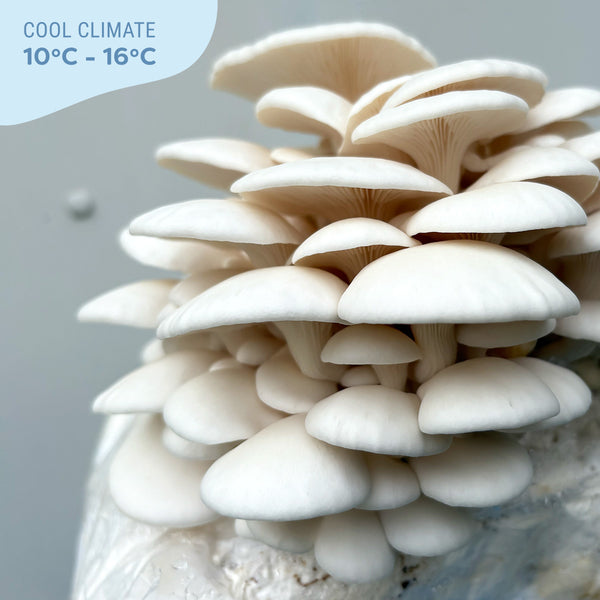
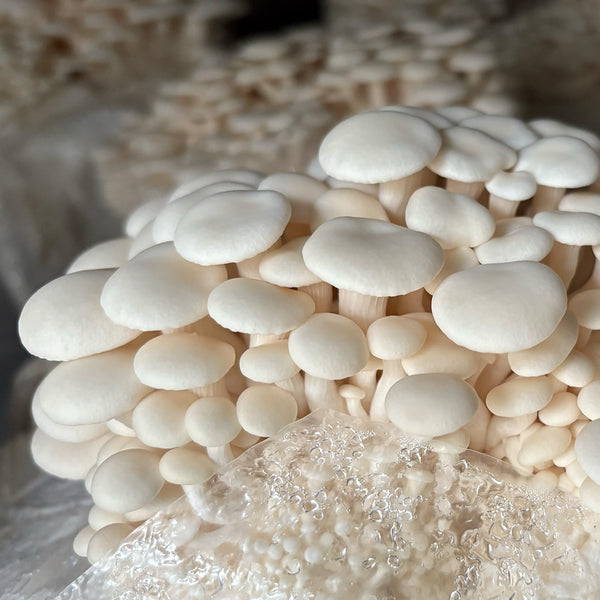
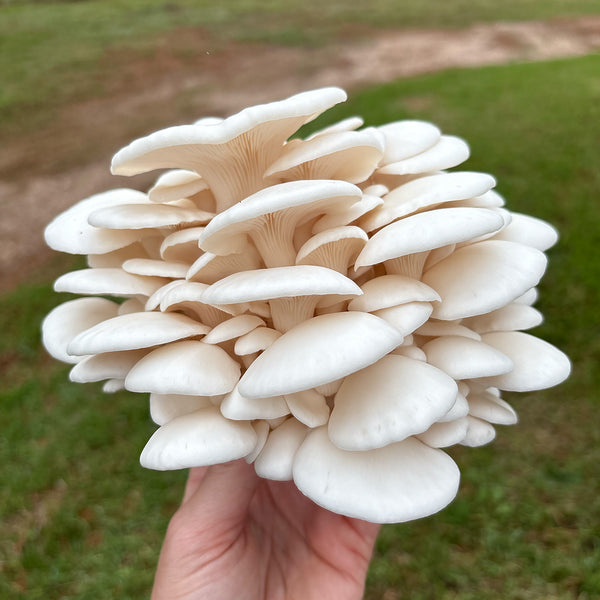
Snow White Oyster Small Cap mushroom grain spawn is a fully colonised spawn ready to inoculate bulk substrates. It produces clusters of bright white, small-capped oyster mushrooms that are well suited to punnet packaging and market sales. This strain performs well on Master's Mix and supplemented hardwood sawdust substrates. Suitable for home growers, market gardeners and commercial mushroom farms seeking uniform caps and consistently sized clusters.

Snow White Oyster (Small Cap) Mushroom Grain Spawn
Sale price
$45.00
Tax included
Strain characteristics
Species: Pleurotus ostreatus
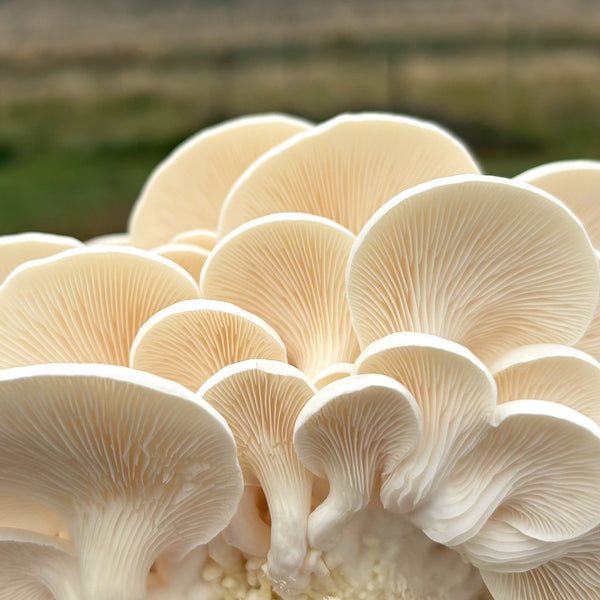
Cap colour: Bright white
Cap size: Small, round, uniform
Growth rate: Fast (3-4 weeks from inoculation to harvest)
Best substrates: Master's Mix, supplemented hardwood sawdust
Fruiting temperature: 10-16°C (critical for pin formation of this strain)
Fruiting humidity: 85-90% humidity
Difficulty: Beginner to Intermediate
Best suited to: Growers with climate controlled fruiting rooms
Shipping & storage
- Grain spawn is heat sensitive during transit, we strongly recommend choosing Express Post for orders containing grain spawn.
- Unpack and refrigerate your spawn on arrival for all species except Pink Oyster.
- Spawn is alive with mushroom mycelium and should be used as soon as practical for best results.
- You can store grain spawn refrigerated for 3-6 months.
- We ship Australia-wide.
For more information please visit our Shipping & Delivery Page.
CULTIVATOR'S TIPS
Why grow this variety?
If you're looking for a crisp white oyster with uniform, dainty caps, then Snow White Oyster Small Cap is the strain for you.
The smaller cap size is perfectly suited to punnet packaging, while the clusters still hold impressive weight. In our experience, this strain consistently produces first flushes of around 400g from a 2kg Master's Mix substrate block under favourable growing conditions. While not quite as meaty as its larger capped Snow White counterpart, it remains a reliable and productive performer.
To trigger pin formation, this strain requires cooler temperatures below 16°C. For best results, grow it in a climate-controlled fruiting room or seasonally during the cooler months of autumn and winter, depending on your local climate.
Strain comparisons
| Feature | Snow White | Snow White Small Cap |
| Cap size | Larger | Smaller |
| Texture | Meatier | More delicate |
| Presentation | Big clusters | Excellent for punnets |
| Yields | Higher | Slightly lower |
How to use grain spawn
Mushroom grain spawn is used to transfer mushroom mycelium into a bulk substrate, a process known as inoculation. Grain is the industry standard for spawn production, with wheat, rye, millet and sorghum commonly used. At Little Acre, we use Australian-grown wheat grain.
Once mixed through a suitable substrate, the mycelium colonises the material, eventually producing mushrooms. Grain spawn itself is not intended as a fruiting substrate, as it lacks the moisture retention and structural components needed for strong mushroom yields.
Common bulk substrates include pasteurised straw, sugarcane mulch, hardwood sawdust and pelletised blends such as Master's Mix, one of the most popular substrates for growing gourmet mushrooms. Depending on the substrate, preparation may involve pasteurisation or sterilisation before inoculation.
After preparing your substrate, mix in the grain spawn thoroughly and allow the mycelium to colonise. As with all mushroom cultivation, clean working practices are essential to minimise contamination and achieve the best results. Inoculations should ideally be performed in front of a laminar flow cabinet or inside a still air box to prevent contamination.
Choosing your growing method
DIY Grow Blocks
Best for growers who want to learn the full process and make their own substrate.
Our Home Growing Supplies Pack includes everything you need to make up to 10 mushroom grow blocks using the hot water pasteurisation method. The pack include:
- grain spawn
- pelletised substrate
- mushroom grow bags
- hydrate lime
- zip ties
- detailed instructions
This is the most cost-effective way to produce multiple grow blocks and is ideal for hobby growers wanting a hands-on cultivation experience.
Ready-to-grow mushrooms
Best for growers who want the simplest path to growing mushrooms.
Our ready-to-fruit grow blocks arrive fully prepared and colonised. Simply place the block into the correct fruiting conditions and watch mushrooms grow!
No substrate preparation, pasteurisation or inoculation required. These blocks are ideal for beginner growers who want to master fruiting a variety of mushrooms.
Grow at commercial scale
Best for growers producing mushrooms for markets or wholesale sale.
Our grain spawn is trusted by mushroom growers across Australia, from small-scale farms through to commercial operations. Our spawn is produced to deliver reliable colonisation, consistent performance and strong yields.
We offer wholesale pricing for ongoing farm customers, as well as bulk discounts or larger orders such as our Big Spawn Box.
FAQs
What is the difference between Snow White Oyster and Snow White Oyster Small Cap?
As the name suggests, the main difference between Snow White Oyster and Snow White Oyster Small Cap strains is the cap size of the mushroom. Snow White Oyster Small Cap has a smaller, rounded cap, perfect for punnet packaging. The standard Snow White Oyster strain can grow really large caps and has a meatier, thicker cap.
Both strains taste very similar. Size and texture are the main differences.
What are the ideal growing conditions for Snow White Oyster Small Cap?
The ideal growing conitions Snow White Oyster Small Cap are:
Fruiting Temperature: 10°C - 16°C
Fruiting Humidity: 85 - 90%
Fruiting CO2: 500 - 800ppm
It is critical to have cool temperatures under 16°C to initiate pin sets for this strain. If you can't achieve cold temperatures but want to grow a white coloured oyster mushroom then we would recommend Warm White Oyster.
What are the benefits of small-cap oyster mushrooms?
Choosing a small-cap oyster strain has many advantages. The consistent size and shape of the clusters makes the packing process more efficient which is important if you're growing and selling packaged mushrooms commercially. The smaller cap size may also benefit restaurant customers as chefs can rely on the mushrooms being consistent in size and shape for presentation of dishes.